Register a fresh account and start operating it like a seasoned one, and it will be gone within a week — often within a day. Not because you broke a rule, but because platforms in 2026 treat every new account as guilty until proven human. The first thirty days are an audition, and most operators fail it by skipping straight to the performance.
Warm-up is the discipline of passing that audition deliberately. This playbook covers what platforms actually measure in a new account’s first month, the three-phase timeline that builds trust without wasting weeks, the mistakes that silently reset your progress, and how to run warm-up at scale across a whole account matrix.
Why New Accounts Die in the First Week
Every major platform maintains some version of a trust score — an internal rating of how likely an account is to be a real person acting normally. Aged accounts with consistent history start each session with credit. A fresh account starts at zero, which means it gets the strictest version of every check: tighter rate limits, more aggressive anomaly detection, faster escalation to verification or suspension.
That’s why the same action that’s routine for an old account — sending twenty friend requests, posting a link, changing a profile photo and bio in one sitting — can be fatal for a new one. The action isn’t the problem. The timing is. Warm-up is simply the practice of not asking the platform for more trust than you’ve earned yet.
What Platforms Score in the First 30 Days
The scoring models differ by platform, but the early signals cluster into four groups:
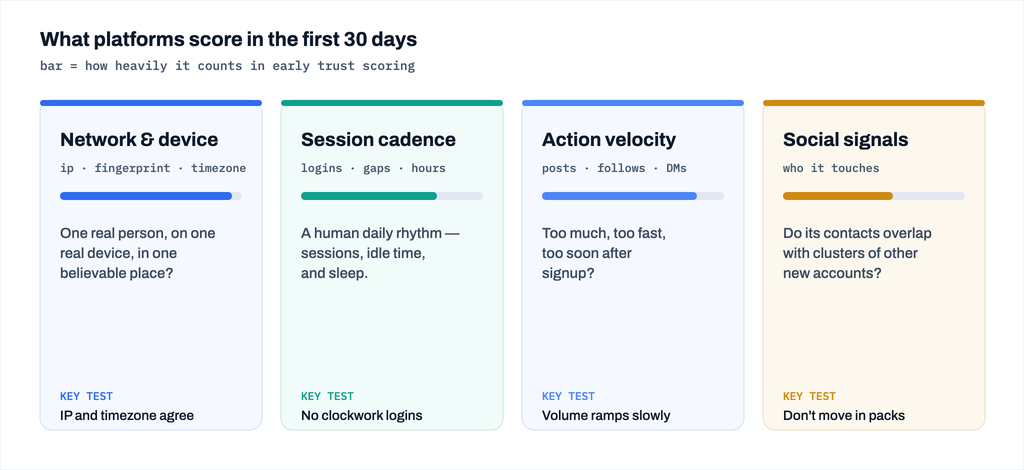
- Network and device. Does the account come from a believable IP on a coherent device? A residential or mobile IP that matches the profile’s stated region, a fingerprint that stays the same on every login, a timezone and locale that agree with the IP. This is the foundation — if it’s wrong, nothing else you do matters.
- Session cadence. Real people have rhythms. They log in at human hours, scroll for a while, leave, come back tomorrow. An account that appears at 3 a.m. sharp every day, works for exactly forty minutes, and never idles reads as a script.
- Action velocity. How much is the account doing, and how soon? Posting, following, messaging, and link-sharing in the first days — especially at volume — are the strongest automation signals a new account can emit.
- Social signals. Who does the account interact with? New accounts that immediately touch the same pages, groups, or targets as a cluster of other new accounts get linked to that cluster — and inherit its reputation.
Before Day One: Get the Environment Right
Warm-up happens inside an environment, and the environment is set before you ever hit “sign up.” Two rules do most of the work:
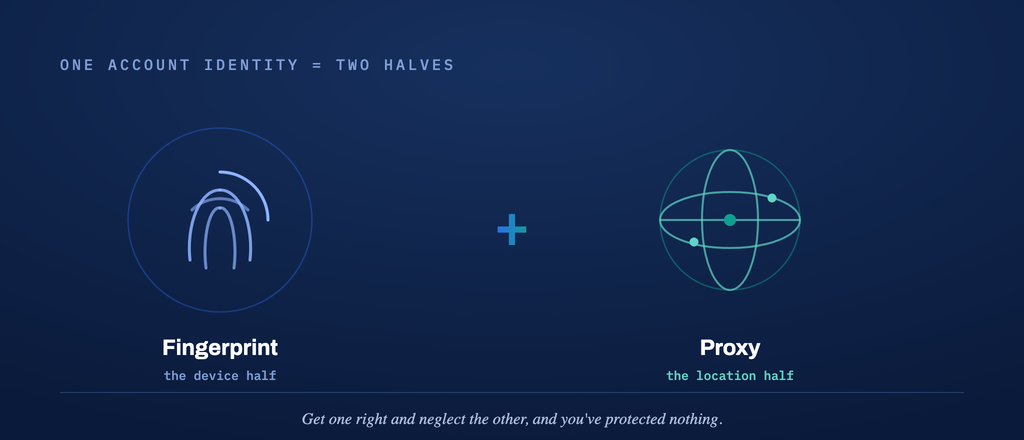
First, one account, one environment, forever. In an anti-detect browser like VMLogin, each profile carries its own fingerprint — Canvas, WebGL, fonts, hardware signals — plus its own cookies and storage. The account must only ever live inside that profile. Every login from the same “device” builds history; a single login from a different one spends it.
Second, one account, one dedicated IP, one matching region. Give the profile a residential or mobile proxy matched to the account’s stated location, and never rotate it mid-warm-up. Mobile IPs buy the most tolerance in the fragile early days. We covered how to pick them in our proxy selection guide — for warm-up, the short version is: sticky sessions, real consumer IPs, region matched to the profile, timezone and language matched to the region.
Get these two right and warm-up is mostly patience. Get either wrong and no amount of careful behavior will save the account.
The Three-Phase Warm-Up Timeline
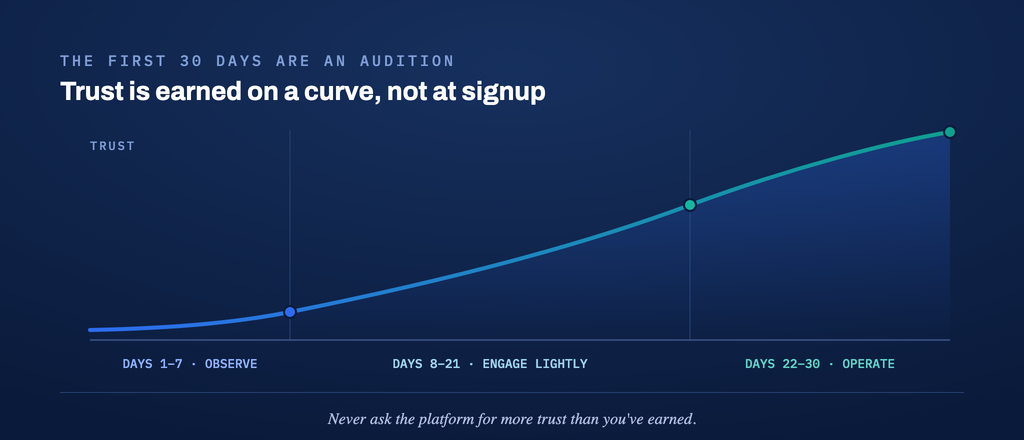
Thirty days is the working standard for most platforms in 2026 — shorter for low-stakes accounts, longer for ad and payment accounts. The month splits into three phases:
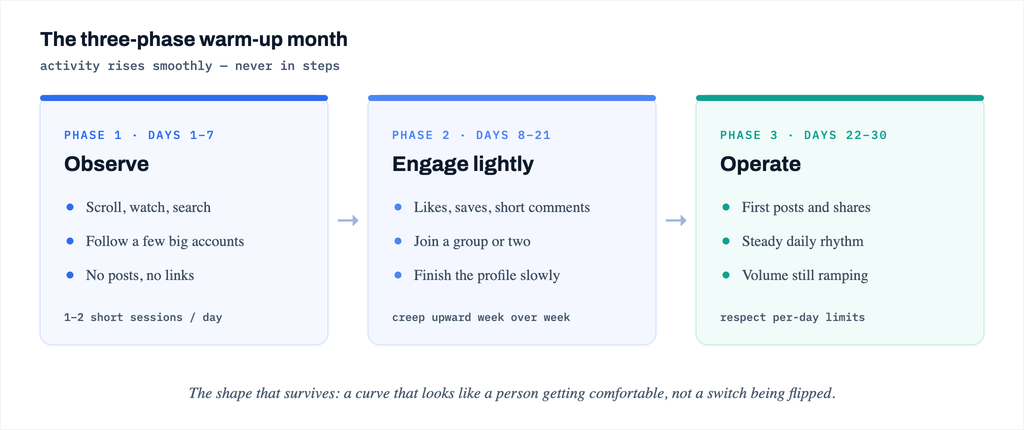
- Phase 1 — Observe (days 1–7). Behave like a curious newcomer. Log in once or twice a day at natural hours, scroll the feed, watch videos, search a few topics, follow a small handful of large mainstream accounts. Complete the basics of the profile — name, photo — but don’t rush to fill in everything at once. No posting, no links, no outreach.
- Phase 2 — Light engagement (days 8–21). Start reacting: likes, saves, the occasional short comment in normal language. Join a group or two. Finish the profile gradually. Session length and daily actions creep upward week over week — the curve should look like a person getting comfortable, not a switch being flipped.
- Phase 3 — Normal operation (days 22–30). First original posts, first shares, first meaningful conversations. By the end of the month the account runs a steady daily rhythm and can begin its real work — still ramping volume gradually, still respecting per-day limits.
The percentages matter less than the shape: activity that rises smoothly from near-zero. Any step-change in behavior is a flag, and that stays true for the account’s whole life.
The Mistakes That Reset the Clock
Most warm-up failures aren’t exotic. The same handful of errors accounts for nearly all of them:
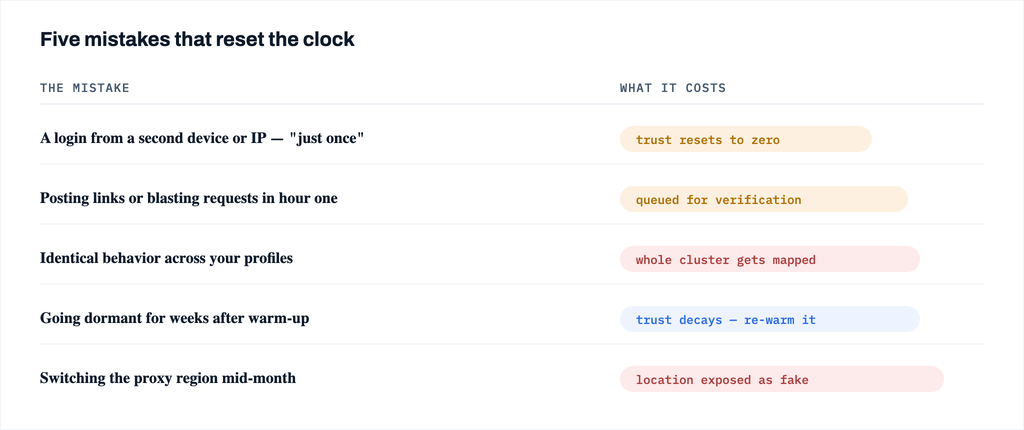
- Logging in from a second device or IP “just once.” One login outside the account’s environment contradicts its entire history. Trust doesn’t dip — it resets.
- Acting immediately after registration. Posting a link or blasting follow requests in hour one is the single fastest way to get a new account queued for verification.
- Running identical behavior across profiles. If ten accounts like the same posts in the same order on the same schedule, the platform doesn’t ban one — it maps the cluster and bans them together. Vary targets, timing, and volume per account.
- Going dormant after warm-up. Trust decays. An account warmed for a month and then shelved for two returns as a near-stranger and needs re-warming before heavy use.
- Changing the proxy region mid-stream. An account that “moves countries” during its first month has told the platform its location was never real.
Scaling Warm-Up Across a Matrix
For a single account, warm-up is a calendar. For fifty, it’s an operations problem — and the temptation is to automate all fifty in lockstep, which is exactly the synchronized behavior platforms cluster on.
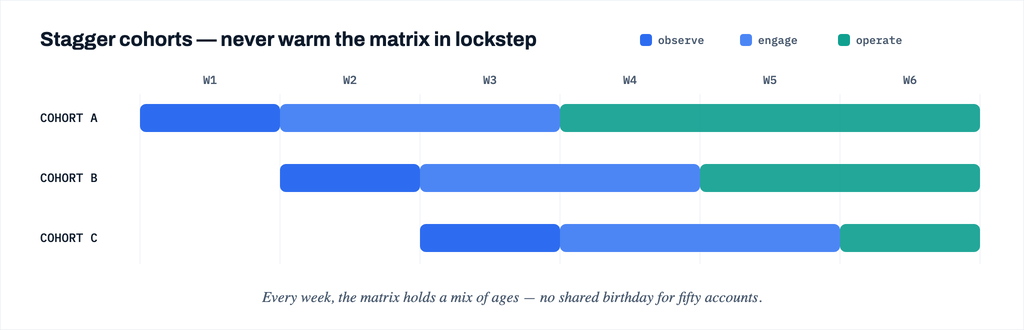
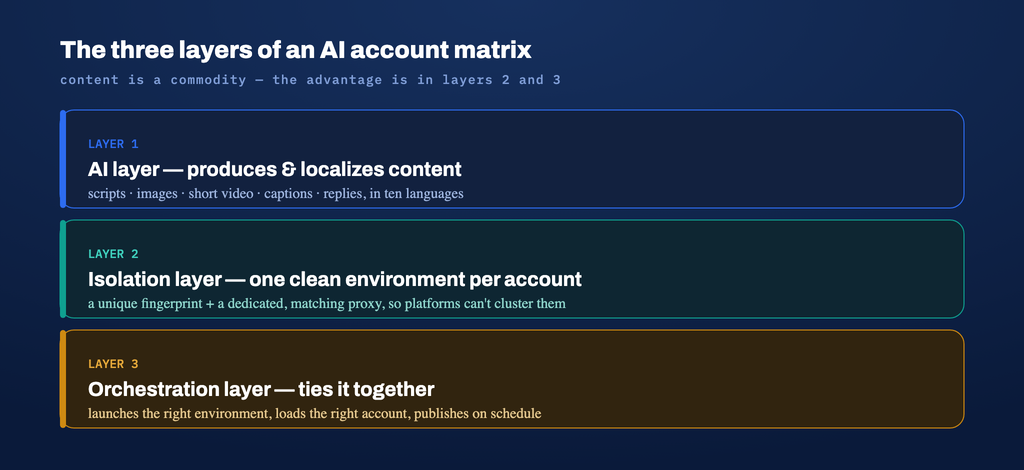
The answer is to stagger cohorts and randomize within them. Bring accounts online in small batches a week apart, so your matrix always contains a mix of ages instead of fifty accounts crossing every threshold on the same day. Within a batch, let a scheduler vary login times, session lengths, and action counts per profile within human bounds. VMLogin’s local API lets you provision each profile — fingerprint, proxy, timezone — at creation time and drive sessions programmatically, so cohorts can run this way without an operator babysitting each account; we walked through that architecture in our account matrix guide.
Automation handles the cadence. The plan — what each cohort does, when it graduates a phase, what it never does early — stays a human decision.
Bringing It Together
New accounts don’t get banned for what they do; they get banned for doing it too soon, from the wrong environment, in suspicious sync with others. Fix the environment before day one — one profile, one fingerprint, one dedicated regional IP. Spend the first month earning trust in three phases: observe, engage lightly, then operate. Avoid the handful of mistakes that reset the clock, and when you scale, stagger your cohorts so no two accounts live identical lives. Thirty patient days is cheap. Replacing a banned account matrix is not.